Specify a parametric model (which may represent the analysis or imputation model). Optionally, if a dataset is supplied, explore whether the observed relationships in the specified dataset are consistent with the proposed parametric model.
Arguments
- formula
A symbolic description of the model to be fitted, with the dependent variable on the left of a ~ operator, and the covariates, separated by + operators, on the right, specified as a string
- family
A description of the error distribution and link function to be used in the model, specified as a string; family functions that are supported are "gaussian(identity)" and "binomial(logit)"
- by
Optional stratification variable(s), specified as a string (space delimited) or a list of factors; if specified, the parametric model will be fit for each subset of the data determined by the values of the factor(s)
- data
Optionally, a data frame containing all the variables stated in the formula and if specified, stratification variable(s)
- plot
If TRUE (the default), and a dataset is supplied, displays a plot which can be used to explore the form of the specified model; note that stratification variables are ignored in the plot; use plot = FALSE to disable the plot
- message
If TRUE (the default), and a dataset is supplied, displays a message indicating whether the relationships between the dependent variable and covariates are likely to be correctly specified or not; use message = FALSE to suppress the message
Value
An object of type 'mimod' (a list containing the specified formula, family, and, if specified, dataset name). Optionally, if required and a dataset is supplied, a message indicating whether the relationships between the dependent variable and covariates are likely to be correctly specified or not.
References
Curnow E, Carpenter JR, Heron JE, et al. 2023. Multiple imputation of missing data under missing at random: compatible imputation models are not sufficient to avoid bias if they are mis-specified. J Clin Epidemiol. doi:10.1016/j.jclinepi.2023.06.011
Examples
# Example (incorrectly) assuming a linear relationship
checkModSpec(formula="bmi7~matage+mated+pregsize",
family="gaussian(identity)", data=bmi)
 #> Method used to explore model specification: regression of model
#> residuals (y) on a fractional polynomial of the fitted values
#> (fitvals). If stratification variable(s) are specified, results are
#> subsetted by the values of these variable(s).
#>
#> Call:
#>
#> glm(formula = y ~ ., family = family, data = data, weights = weights,
#>
#> offset = offset, x = TRUE, y = TRUE)
#>
#> Coefficients:
#>
#> Estimate Std. Error t value Pr(>|t|)
#>
#> (Intercept) -5.908e-15 5.512e-02 0.00 1
#>
#> fitvals.1 -5.268e-02 3.215e-03 -16.39 <2e-16 ***
#>
#> fitvals.2 1.629e-02 9.926e-04 16.41 <2e-16 ***
#>
#> ---
#>
#> Signif. codes: 0 ‘***’ 0.001 ‘**’ 0.01 ‘*’ 0.05 ‘.’ 0.1 ‘ ’ 1
#>
#> (Dispersion parameter for gaussian family taken to be 1.798351)
#>
#> Null deviance: 1547.8 on 591 degrees of freedom
#>
#> Residual deviance: 1059.2 on 589 degrees of freedom
#>
#> AIC: 2032.4
#>
#> Number of Fisher Scoring iterations: 2
#>
#> Interpretation: A weak relationship between the model residuals and
#> fitted values means there is little evidence of model
#> mis-specification. A strong relationship between the model residuals
#> and fitted values means the model may be mis-specified.
#>
#> Note that an intercept-only model will be displayed if there is a weak
#> relationship between the model residuals and fitted values.
#>
#> Consider whether the specified model is plausible for your study, and
#> update it accordingly. Note that the observed relationships may be
#> distorted by data missing not at random.
#>
#> Note: This function explores the specification of your model. In
#> addition, imputation models must be 'compatible' with the analysis
#> model. This means that imputation models must include all the same
#> variables in the same form as the analysis model. Imputation models may
#> also contain additional, 'auxiliary', variables that are predictive of
#> the missing values.
#>
#> Imputation models must include any interactions or non-linear terms
#> implied by the analysis model. Imputation models for partially-observed
#> covariates in a survival analysis must include a compatible form of the
#> survival outcome - see, for example, the 'approximately compatible'
#> approach for Cox regression (White and Royston, 2012;
#> https://doi.org/10.1002/sim.3618); this method can be implemented using
#> 'mice::nelsonaalen()'.
#>
#> If it is difficult to specify imputation models in a form that is
#> compatible with your analysis model, consider using an alternative
#> approach. See, for example, the substantive model compatible approach
#> (Bartlett et al, 2015; https://doi.org/10.1177/0962280214521348); this
#> method can be implemented using 'smcfcs::smcfcs()'
## For the example above, (correctly) assuming a quadratic relationship
checkModSpec(formula="bmi7~matage+I(matage^2)+mated+pregsize",
family="gaussian(identity)", data=bmi)
#> Method used to explore model specification: regression of model
#> residuals (y) on a fractional polynomial of the fitted values
#> (fitvals). If stratification variable(s) are specified, results are
#> subsetted by the values of these variable(s).
#>
#> Call:
#>
#> glm(formula = y ~ ., family = family, data = data, weights = weights,
#>
#> offset = offset, x = TRUE, y = TRUE)
#>
#> Coefficients:
#>
#> Estimate Std. Error t value Pr(>|t|)
#>
#> (Intercept) -5.908e-15 5.512e-02 0.00 1
#>
#> fitvals.1 -5.268e-02 3.215e-03 -16.39 <2e-16 ***
#>
#> fitvals.2 1.629e-02 9.926e-04 16.41 <2e-16 ***
#>
#> ---
#>
#> Signif. codes: 0 ‘***’ 0.001 ‘**’ 0.01 ‘*’ 0.05 ‘.’ 0.1 ‘ ’ 1
#>
#> (Dispersion parameter for gaussian family taken to be 1.798351)
#>
#> Null deviance: 1547.8 on 591 degrees of freedom
#>
#> Residual deviance: 1059.2 on 589 degrees of freedom
#>
#> AIC: 2032.4
#>
#> Number of Fisher Scoring iterations: 2
#>
#> Interpretation: A weak relationship between the model residuals and
#> fitted values means there is little evidence of model
#> mis-specification. A strong relationship between the model residuals
#> and fitted values means the model may be mis-specified.
#>
#> Note that an intercept-only model will be displayed if there is a weak
#> relationship between the model residuals and fitted values.
#>
#> Consider whether the specified model is plausible for your study, and
#> update it accordingly. Note that the observed relationships may be
#> distorted by data missing not at random.
#>
#> Note: This function explores the specification of your model. In
#> addition, imputation models must be 'compatible' with the analysis
#> model. This means that imputation models must include all the same
#> variables in the same form as the analysis model. Imputation models may
#> also contain additional, 'auxiliary', variables that are predictive of
#> the missing values.
#>
#> Imputation models must include any interactions or non-linear terms
#> implied by the analysis model. Imputation models for partially-observed
#> covariates in a survival analysis must include a compatible form of the
#> survival outcome - see, for example, the 'approximately compatible'
#> approach for Cox regression (White and Royston, 2012;
#> https://doi.org/10.1002/sim.3618); this method can be implemented using
#> 'mice::nelsonaalen()'.
#>
#> If it is difficult to specify imputation models in a form that is
#> compatible with your analysis model, consider using an alternative
#> approach. See, for example, the substantive model compatible approach
#> (Bartlett et al, 2015; https://doi.org/10.1177/0962280214521348); this
#> method can be implemented using 'smcfcs::smcfcs()'
## For the example above, (correctly) assuming a quadratic relationship
checkModSpec(formula="bmi7~matage+I(matage^2)+mated+pregsize",
family="gaussian(identity)", data=bmi)
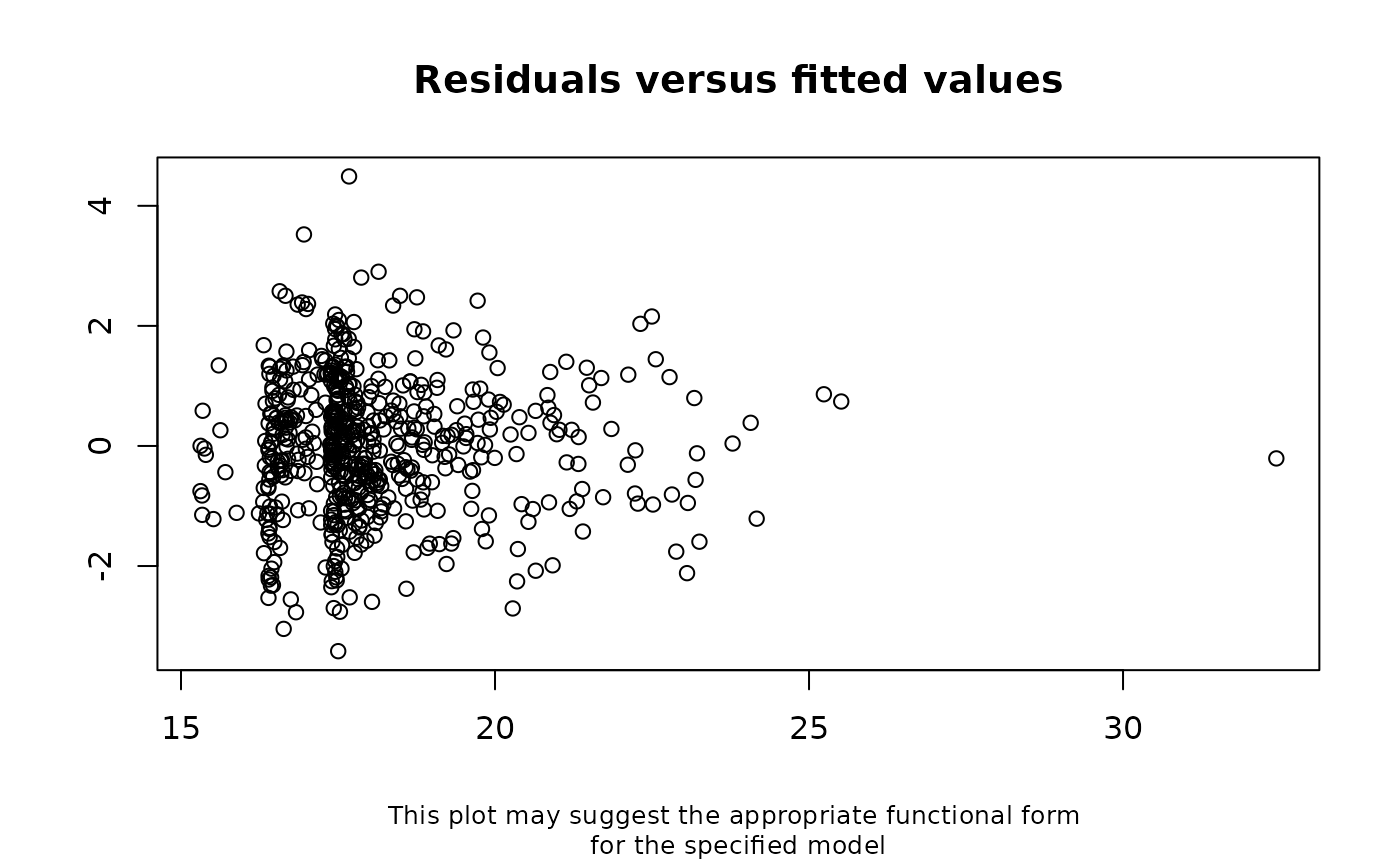 #> Method used to explore model specification: regression of model
#> residuals (y) on a fractional polynomial of the fitted values
#> (fitvals). If stratification variable(s) are specified, results are
#> subsetted by the values of these variable(s).
#>
#> Call:
#>
#> glm(formula = y ~ ., family = family, data = data, weights = weights,
#>
#> offset = offset, x = TRUE, y = TRUE)
#>
#> Coefficients:
#>
#> Estimate Std. Error t value Pr(>|t|)
#>
#> (Intercept) -3.409e-17 4.560e-02 0 1
#>
#> (Dispersion parameter for gaussian family taken to be 1.230712)
#>
#> Null deviance: 727.35 on 591 degrees of freedom
#>
#> Residual deviance: 727.35 on 591 degrees of freedom
#>
#> AIC: 1805.9
#>
#> Number of Fisher Scoring iterations: 2
#>
#> Interpretation: A weak relationship between the model residuals and
#> fitted values means there is little evidence of model
#> mis-specification. A strong relationship between the model residuals
#> and fitted values means the model may be mis-specified.
#>
#> Note that an intercept-only model will be displayed if there is a weak
#> relationship between the model residuals and fitted values.
#>
#> Consider whether the specified model is plausible for your study, and
#> update it accordingly. Note that the observed relationships may be
#> distorted by data missing not at random.
#>
#> Note: This function explores the specification of your model. In
#> addition, imputation models must be 'compatible' with the analysis
#> model. This means that imputation models must include all the same
#> variables in the same form as the analysis model. Imputation models may
#> also contain additional, 'auxiliary', variables that are predictive of
#> the missing values.
#>
#> Imputation models must include any interactions or non-linear terms
#> implied by the analysis model. Imputation models for partially-observed
#> covariates in a survival analysis must include a compatible form of the
#> survival outcome - see, for example, the 'approximately compatible'
#> approach for Cox regression (White and Royston, 2012;
#> https://doi.org/10.1002/sim.3618); this method can be implemented using
#> 'mice::nelsonaalen()'.
#>
#> If it is difficult to specify imputation models in a form that is
#> compatible with your analysis model, consider using an alternative
#> approach. See, for example, the substantive model compatible approach
#> (Bartlett et al, 2015; https://doi.org/10.1177/0962280214521348); this
#> method can be implemented using 'smcfcs::smcfcs()'
#> Method used to explore model specification: regression of model
#> residuals (y) on a fractional polynomial of the fitted values
#> (fitvals). If stratification variable(s) are specified, results are
#> subsetted by the values of these variable(s).
#>
#> Call:
#>
#> glm(formula = y ~ ., family = family, data = data, weights = weights,
#>
#> offset = offset, x = TRUE, y = TRUE)
#>
#> Coefficients:
#>
#> Estimate Std. Error t value Pr(>|t|)
#>
#> (Intercept) -3.409e-17 4.560e-02 0 1
#>
#> (Dispersion parameter for gaussian family taken to be 1.230712)
#>
#> Null deviance: 727.35 on 591 degrees of freedom
#>
#> Residual deviance: 727.35 on 591 degrees of freedom
#>
#> AIC: 1805.9
#>
#> Number of Fisher Scoring iterations: 2
#>
#> Interpretation: A weak relationship between the model residuals and
#> fitted values means there is little evidence of model
#> mis-specification. A strong relationship between the model residuals
#> and fitted values means the model may be mis-specified.
#>
#> Note that an intercept-only model will be displayed if there is a weak
#> relationship between the model residuals and fitted values.
#>
#> Consider whether the specified model is plausible for your study, and
#> update it accordingly. Note that the observed relationships may be
#> distorted by data missing not at random.
#>
#> Note: This function explores the specification of your model. In
#> addition, imputation models must be 'compatible' with the analysis
#> model. This means that imputation models must include all the same
#> variables in the same form as the analysis model. Imputation models may
#> also contain additional, 'auxiliary', variables that are predictive of
#> the missing values.
#>
#> Imputation models must include any interactions or non-linear terms
#> implied by the analysis model. Imputation models for partially-observed
#> covariates in a survival analysis must include a compatible form of the
#> survival outcome - see, for example, the 'approximately compatible'
#> approach for Cox regression (White and Royston, 2012;
#> https://doi.org/10.1002/sim.3618); this method can be implemented using
#> 'mice::nelsonaalen()'.
#>
#> If it is difficult to specify imputation models in a form that is
#> compatible with your analysis model, consider using an alternative
#> approach. See, for example, the substantive model compatible approach
#> (Bartlett et al, 2015; https://doi.org/10.1177/0962280214521348); this
#> method can be implemented using 'smcfcs::smcfcs()'